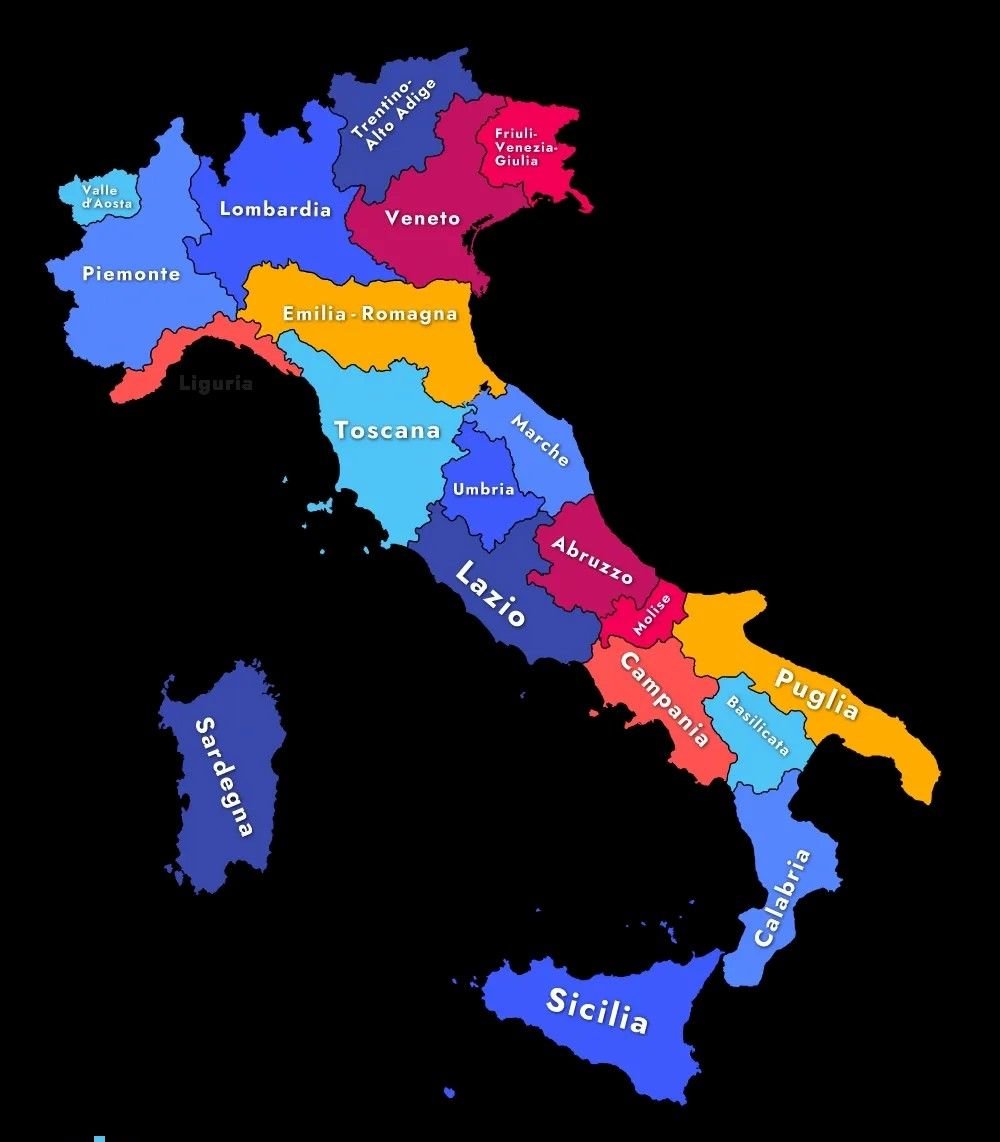
Italy consists of 20 administrative regions, each showcasing unique cultures, landscapes, and cuisines, varying from Alpine mountains in the north to Mediterranean islands. Five regions (Sicily, Sardinia, Valle d’Aosta, Trentino-Alto Adige, Friuli-Venezia Giulia) have special autonomy, while 15 function under regular laws.
Regions of Italy (by Geographical Division):
Northern Italy:
Aosta Valley (Valle d’Aosta): Alpine region bordering France/Switzerland.
Piedmont (Piemonte): Home to Turin, famous for wine and truffles.
Liguria: Coastal region known for the Italian Riviera and Genoa.
Lombardy (Lombardia): Economic hub with Milan and the Lakes.
Trentino-South Tyrol (Trentino-Alto Adige): Autonomous region in the Dolomites.
Veneto: Features Venice and Verona.
Friuli-Venezia Giulia: Bordering Austria and Slovenia.
Emilia-Romagna: Culinary center with cities like Bologna and Parma.
Central Italy:
Tuscany (Toscana): Renowned for Florence, art, and vineyards.
Umbria: Known as the “green heart” with medieval towns.
Marche: Features Adriatic beaches and rugged mountains.
Lazio: Home to Rome, the national capital.
Abruzzo: Known for mountainous national parks.
Southern Italy:
Molise: A small, rugged region.
Campania: Features Naples, Pompeii, and the Amalfi Coast.
Apulia (Puglia): Known for olive groves and whitewashed towns.
Basilicata: A mountainous, rustic region.
Calabria: The “toe” of the boot, known for beaches and spicy food.
Insular Italy (Islands):
Sicily (Sicilia): Largest Mediterranean island with diverse history.
Sardinia (Sardegna): Known for pristine beaches and ancient ruins.
Key Facts:
Special Statute Regions: These five (Sicily, Sardinia, Valle d’Aosta, Trentino-Alto Adige, Friuli-Venezia Giulia) have greater legislative and financial autonomy due to cultural or geographical uniqueness.
Capital Cities: Each region has a capital, such as Milan (Lombardy), Venice (Veneto), Florence (Tuscany), and Naples (Campania).
Leave a Reply